
A few weeks ago someone asked me, half joking and half frustrated, “How does a butcher run out of lamb cutlets?”
It’s a fair question. In most butcher shops, that doesn’t happen. You call a distributor, order what you need, and it turns up the next day. Simple. But our supply chain doesn’t work like that and it never really has.
How Most Meat Supply Chains Work
In Australia, especially in the major cities, where most businesses don’t have direct access to the farmers most butchers buy through third-party distributors.
There are large processors and abattoirs breaking down animals into what’s called “boxed meat.” The carcass is processed into primals (the major muscle groups) boxed up, and sold through distributors who sit between the processor and the butcher.
Need eye fillet tomorrow?
Need just lamb racks?
Need only pork bellies?
You call, they deliver, often within 24 hours. It’s efficient. It’s flexible. It allows butchers to order exactly what they need, when they need it. And that’s where things start to look different for us.
The Organic Problem
Very few third-party distributors carry significant volumes of certified organic meat. When we started, there was virtually no organic boxed meat available at scale. If you wanted organic, you bought whole carcasses. Direct from farmers. No safety net. Now, buying whole animals sounds romantic (nose-to-tail, whole-animal respect) and philosophically, we love it.
But here’s the practical reality:
From one whole lamb, you only get two racks, approx 800g.
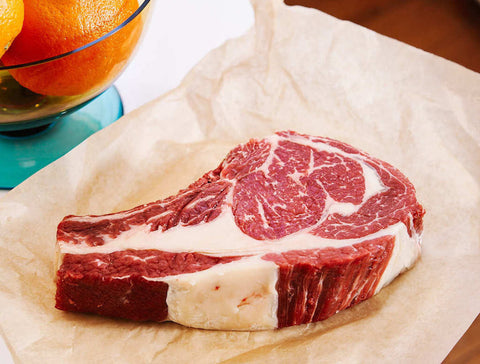
From a 600kg steer, you get roughly 3.6kg of usable eye fillet.
We go through around 180–200kg of eye fillet a week across our stores. Do the maths. That’s a lot of cattle. Because there is only a limited number of organic cattle killed every single week, making sure we get a number of eye fillets can be challenging.
There is also the question of what happens to the other cuts, chuck, blade, brisket, shin, topside. These all make up a much larger percentage of the animal and need to be moved. If customers all want steaks one week, we can’t just order more steaks. We have to consider a more balanced approach to the whole animal.
That’s the organic supply chain challenge.
Direct Relationships
From the very beginning, our model has been about working directly with farmers.
Our dad started the business in 1999. Before that, he was working in organic fruit and vegetables. When one of the growers he worked with, Neville Bredden, heard we were opening butcher shops, he changed from herbs to cattle and started supplying us with beef. We worked with Neville and his wife Carol for nearly 20 years until their retirement.
Relationships like these set the tone for how we operate today.
Today, the majority of our beef comes from Clayton’s Organics, a family-run operation. I visit the farms regularly. We speak directly. We understand each other’s pressures and we work together. This kind of working relationship I have found is very unique to the organic industry. We all believe in what we’re doing and ultimately our goal is to bring healthier produce to as many people as we can.
Our lamb comes from Bultarra Saltbush Lamb outside of Port Augusta in South Australia. We’ve worked with Jamie and Verity for about a decade and they supply some of the best quality lamb on the market.
Our regenerative Berkshire pork comes from Jason and Belinda at McIver Farm, a partnership going back to the early 2010s.
Our organic chicken comes from Greg and Katrina at Bantry Organic Chicken, who are one of the few operators large enough to meet our demand while staying true to organic principles.
The key thing about all these relationships is that they’re not just transactional, they’re long-term partnerships. These farms support regional families, local workers, truck drivers, abattoir teams and rural communities. When we commit to them, we’re not just buying meat, we’re backing local jobs and keeping Australian organic farming viable. That’s something I’m incredibly proud of.
Why Supply Fluctuates
Organic farming isn’t industrial farming.
If it’s too hot, the chicken growth rate suffers.
If animals get sick, you can’t just pump them with routine antibiotics and put them back in the organic system.
If seasonal conditions shift, production shifts.
Organic and regenerative systems are more exposed to natural variability — because they’re built to work with nature, not override it.
Organic supply is also influenced by global demand. A significant portion of Australian organic meat is exported to markets like the US, Europe and the Middle East, where certified product attracts strong prices.
That global demand helps keep organic farming viable in Australia, but it also means supply can tighten locally from time to time.
Sometimes we simply can’t access more products, even if we want to. And because we don’t rely on alternative distributors carrying backup organic stock, when supply tightens, it tightens for us too.
Why We Stay the Course
One option would be to bring in product from alternative sources when supply tightens.
But that would mean stepping away from direct relationships and certified integrity.
Instead, we stay consistent.
We work directly with producers.
We process centrally through Richmond.
We make our sausages, smallgoods and marinades by hand.
It’s deliberate.
It requires planning.
It demands trust.
But it means the product in our cabinets aligns with the values we talk about.
The Cost Question
Organic meat is more expensive.
Organic farming is more labour intensive. Yields can be lower. Certification adds cost. And global demand sets strong price benchmarks.
Farmers need to be paid fairly to continue farming organically. Without that, the system collapses.
We support fair pricing because it keeps good farmers farming well.
Why This Matters
The organic supply chain isn’t just about avoiding chemicals.
It’s about:
-
Long-term farmer relationships
-
Respecting the whole animal as best we can
-
Accepting natural variability
-
Building resilience instead of efficiency at all costs
-
Keeping transparency front and centre
It’s taken us over 20 years to build. It’s complex and sometimes imperfect. It doesn’t always give us the product we want at the drop of a hat, but it does give you something far more valuable; a supply chain you can actually trace, understand, and trust.
And in 2026, that matters more than ever.